Can SAMe Help with Depression and Anxiety?
Interest in non-pharmaceutical treatments for depression and anxiety has grown rapidly in recent decades. Among the most discussed are folate and S-adenosylmethionine (SAMe), two natural compounds that play vital roles in the brain’s one carbon metabolic cycle.
What Is SAMe and How Does It Work?
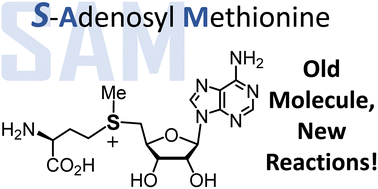
S-adenosylmethionine (SAMe) is a compound made naturally in the body from the amino acid methionine and adenosine triphosphate (ATP). It acts as a methyl donor a chemical helper used to make or regulate hormones, proteins, and neurotransmitters such as serotonin, dopamine, and norepinephrine (Papakostas et al., 2012).
In simpler terms, SAMe helps the brain perform many of the chemical reactions necessary for stable mood and emotional regulation.
Could SAMe Help Treat Depression and Anxiety?
Evidence suggests that SAMe supplementation may improve symptoms of depression, particularly when used alongside standard antidepressants. Papakostas et al. (2012) reviewed clinical trials showing that SAMe can be as effective as tricyclic antidepressants and may enhance response in treatment-resistant cases.
A later meta-analysis by Sarris et al. (2016) found that SAMe, methylfolate, and omega-3 fatty acids were among the most promising “nutraceuticals” for mood disorders.
However, while SAMe has demonstrated antidepressant effects, evidence for anxiety disorders remains limited. Its influence on neurotransmitters could indirectly help anxiety, but more focused research is needed.
Benefits and Challenges
Benefits
- May improve depressive symptoms with fewer side effects than traditional antidepressants.
- Supports methylation and neurotransmitter balance naturally.
- Can be useful for individuals with low folate or B-vitamin levels.
Challenges
- Oral SAMe supplements vary in bioavailability and potency.
- Combining SAMe with SSRIs or MAOIs may increase serotonin syndrome risk (Mayo Clinic, 2024).
- Long-term data on safety and optimal dosing are still limited.
Other Nutritional Interventions
- Folate and Vitamin B12: Essential for the same methylation cycle as SAMe; deficiency is common in people with depression.
- Omega-3 Fatty Acids: EPA-rich fish oil improves mood and cognitive function (Grosso et al., 2014).
- Vitamin D: Linked to serotonin production and mood regulation.
- N-acetylcysteine (NAC): Reduces oxidative stress and may support neurotransmitter balance (Berk et al., 2014).
Final Thoughts
SAMe isn’t a magic cure, but it’s a scientifically grounded and well tolerated adjunct to traditional treatments. When combined with proper diet, therapy, and medical supervision, SAMe supplementation could help some individuals restore their biochemical balance and improve mood naturally.
References (APA-7)
Berk, M., Sarris, J., Coulson, C. E., & Jacka, F. N. (2014). Nutritional medicine as mainstream in psychiatry. The Lancet Psychiatry, 1(5), 400–412. https://doi.org/10.1016/S2215-0366(14)00051-0
Grosso, G., Galvano, F., Marventano, S., Malaguarnera, M., Bucolo, C., Drago, F., & Caraci, F. (2014). Omega-3 fatty acids and depression: Scientific evidence and biological mechanisms. Oxidative Medicine and Cellular Longevity, 2014, 313570. https://doi.org/10.1155/2014/313570
Mayo Clinic. (2024). SAMe (S-adenosylmethionine) supplement overview. Retrieved from https://www.mayoclinic.org
Papakostas, G. I., Cassiello, C. F., & Iovieno, N. (2012). Folates and S-adenosylmethionine for major depressive disorder. The Canadian Journal of Psychiatry, 57(7), 406–413. https://doi.org/10.1177/070674371205700703
Sarris, J., Murphy, J., Mischoulon, D., Papakostas, G. I., Fava, M., Berk, M., & Ng, C. H. (2016). Adjunctive nutraceuticals for depression: A systematic review and meta-analyses. American Journal of Psychiatry, 173(6), 575–587. https://doi.org/10.1176/appi.ajp.2016.15091228
Lee, Y.-H., Ren, D., Jeon, B., & Liu, H.-w. (2023). S-Adenosylmethionine: more than just a methyl donor. Natural Product Reports, 40(9), 1521–1549. https://doi.org/10.1039/D2NP00086E pubs.rsc.org